Author: Fatemeh Fakhraie

Founder of Muslimah Media Watch. Content marketing nerd who likes figuring out how stuff works and writing about it. I learned everything about being an adult from The Golden Girls.

When it rains, it pours

I’ve had quite a busy week, friends.

Monday, I spoke at the World Affairs Council of Oregon on Muslim women and media activism. It was a wonderful crowd and I felt really positive about the presentation–so positive, in fact, that my cab driver asked me why I was in such a a good mood:

Me: “I just gave a great lecture!”

Cab driver: “Congratulations. What was your lecture on?”
Me: “Muslim women and media activism!”

Cab Driver: “Are you yourself a Muslim woman?”
Me: “Yes, I am!”

Cab Driver: “Well, you don’t act like a Muslim woman!”

Me: “What does a Muslim woman act like?”
Cab Driver: “Well…you don’t have an accent.”

Me: “That’s because I was born and raised here.”

We went on to have a very pleasant conversation about his 55-year-old girlfriend (he himself was a very sharp 79), and how he thought I was “just too smart to stay at the master’s level.”

I hope I gave that cab driver something to think about, and I hope he remembered me if he saw Rep. King’s hearings yesterday. While the hearings proved themselves to be a farce, I was heartened by all those who spoke out against them, especially those outside the Muslim community: Rep. Mike Honda, J-Street, Sen. Harry Reid, etc.

Meanwhile, I’d been battling an insane cold since Tuesday: coughing, phlegm, the whole nasty nine yards. Thankfully, that kept me away from the King hearings and the inevitable blood pressure issues that could ensue.

Unfortunately, it also kept me from dealing effectively with MMW’s server issues. The website has been down for about a week now because our servers have been malfunctioning. Our team has been working pretty hard on it, and I’m confident we’ll be back up and running by Monday, enshallah.

I think I’ll be back up and running by then, too.
What are you doing for International Women’s Day?

International Women’s Day is almost here, friends!

And to celebrate, I’m going to do one of the things I do best: talk!

I’ll be giving a presentation titled, “More Than Meets the Eye: Muslim Women & Global Media Culture” for the World Affairs Council of Oregon on March 7, 2011.

If you’re in town, come check it out! And remember to use next Tuesday to make the world a bit better for the women in your life.

B-A-N-A-N-A-S!

Friends, my time at the Banana 2 conference was brief, but great! Although the weather in Los Angeles has been unseasonably rainy and cold (it actually hailed during our panel), everyone I met was warm and wonderful. And surprisingly, I wasn’t the only bi-racial Persian there! I met Kaywan Shiraz, a managing partner for Kasama Media.

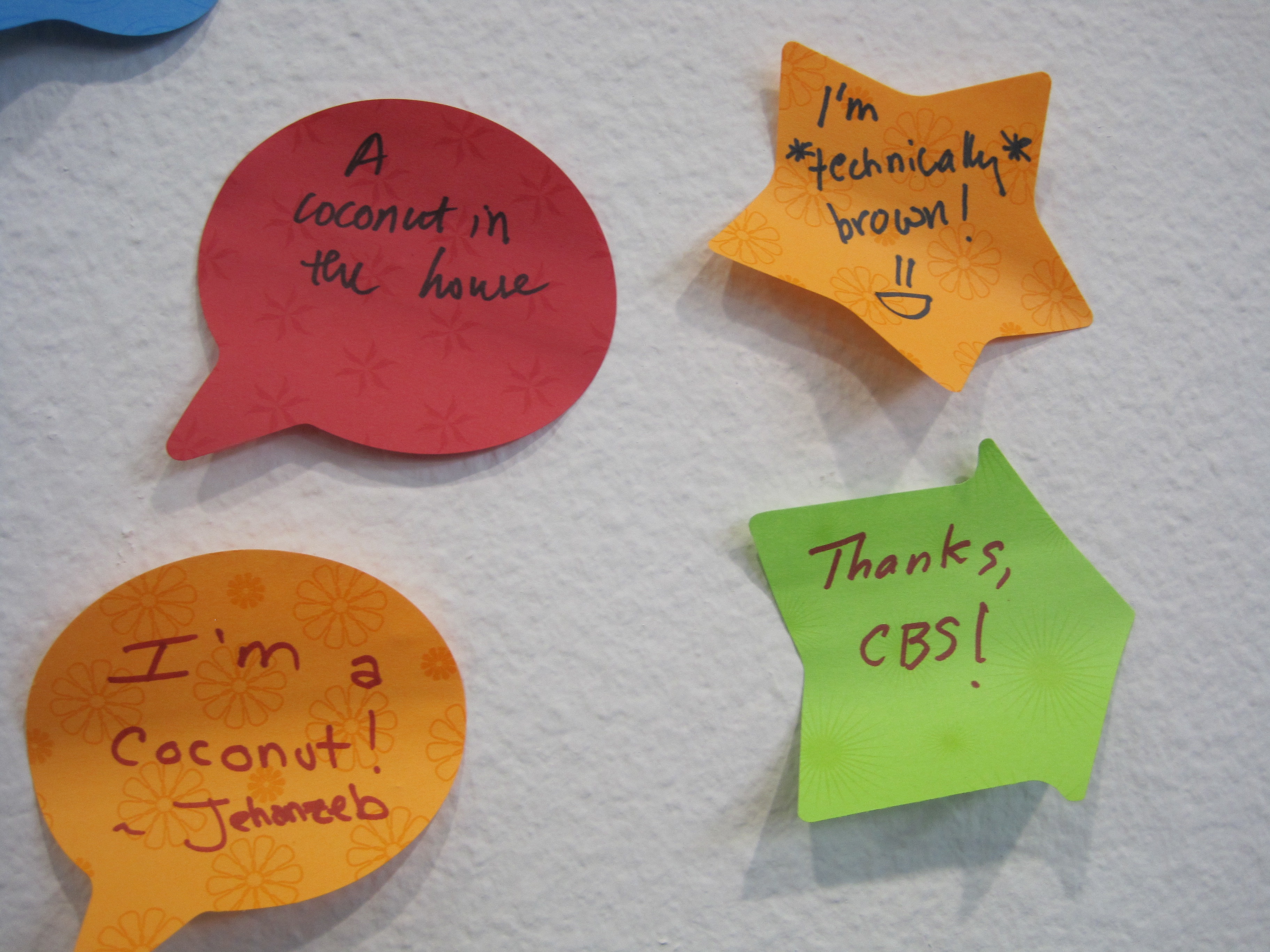
If you didn’t know, the term “banana” refers to Asians (“yellow” on the outside, “white” on the inside). There was some great discussion on what “Asian” includes, and organizer Edward Hong made some great points about how 99% of the conference attendees represented East Asia, but that South and West Asians were underrepresented. In the same edible style, this contingent was referred to as “coconuts” (brown on the outside…). Here are mine and Jehanzeb’s sticky notes:

My note says, "I'm *technically* brown!" and Jehanzeb's says, "I'm a coconut!"

I spoke on a panel about social activism through social media. My co-panelists were the amazing Francis Kai Hwa Wang, Jehanzeb Dar, Marissa Lee, and Cynthia Liu, along with moderation by Keith Kamisugi and input by Edward. You can see the first half of the panel here.

I want to give my deepest gratitude to Edward and everyone else that helped me get to the conference and made me feel welcome. Now if only LA’s weather would follow suit!

This sh*t is bananas

I’ll be at the Banana 2 conference on Saturday, February 26th. And, well, it’s going to be  bananas!

Sorry, couldn’t help myself.

Anyway, Banana 2 is the second-annual gathering of Asian/Pacific Islander American bloggers, and I am lucky enough to be speaking on a panel with Jehanzeb Dar, Marissa Lee, Frances Kai-Hwa Wang, and Cynthia Liu about “Uncovering the Activist in You/Social Media for Social Change.”

Check out the full list of panels here.

Muslimah Media Watch is also a proud sponsor of the conference! If you’re in Los Angeles, be sure to check it out!

I’m going to be published again!

Friends, I’m excited to announce that I’ll be published again in a few months! I’m proud to share that I’ve been included in an amazing group of American Muslim women whose essays will appear in an anthology to be published in early summer 2011. This is directly from the press release:

Islam has become one of the hottest of hot button topics in America. Time Magazine featured the rise of Islamophobia on its cover (August 30, 2010) and attacks on Muslims and mosques are taking place regularly across the United States. Pundits and politicians raise the stakes by questioning whether it is possible for an American to be both a good Muslim and a good citizen. Muslim American women are the subject of endless discussions regarding their role in society, their veils as symbols of oppression or of freedom, their identity, their patriotism.

In this polarized climate, a new book challenges stereotypes about being Muslim in America through the stories of forty women. I Speak for Myself: American Women on Being Muslim (May 2, 2011, White Cloud Press) brings together a diverse group of women, all born and raised in the United States, telling their stories of faith, family, and country. Some contributors wear traditional head coverings (hijab) while some do not. Some are Sunni, some Shi‘i. The writers’ ethnic backgrounds are Arab, African-American, Pakistani, Indian, Iranian, and Afghan.  Each addresses a personal aspect of her life with regards to being a Muslim and being an American.

The book editors are Maria Ebrahimji, executive editorial producer at CNN in Atlanta, and Zahra Suratwala, a writer and editor who owns Zahra Ink, a writing firm in Chicago. The editors wanted to fill a gap in current literature on American Islam by bringing out the stories of American-born Muslim women between the ages of 20 and 40. Ebrahimji notes that “As a member of the mainstream media, I am frequently exposed to the stereotyping of my faith, and this book was created to present the public with more candid, realistic portraits of a diverse group of women who are proud of their faith and their country.”

Readers of I Speak for Myself are presented with a kaleidoscope of deeply personal stories. A common theme linking these intimate self-portraits is the way each woman uniquely defies labeling, simply by defining for herself what it means to be American and Muslim and female.  Each story is a contribution to the larger narrative of life stories and life work of a new generation of Muslim women.

The essays featured in I Speak for Yourself are not intended to be reactionary to the current climate of suspicion towards Islam in America, but they certainly address such suspicion in a very personal way. The contributors embody real everyday American women who struggle with their faith while balancing their careers and private life.

You can pre-order a copy of the book and check out all the contributors (including me) at the website here. You can also check us out on Facebook and Twitter!

I’m making waves online!

…so says the wonderful interfaith site Tikkun! The ever-vibrant Amanda Quraishi profiles me for Tikkun’s “Muslims on the Internet” series:

Needless to say, MMW does not fit neatly into any one blogging category, but it’s precisely for this reason that it’s become a beacon for Muslim women online. “The knowledge that our website is used in university level gender studies classrooms is what I’m most proud of,” Fakhraie tells me. “The majority of my Islamic feminist studies didn’t come to me until late in my college career; I’m supremely happy that we can reach feminists (both Muslim and non-Muslim) earlier. I also think that Muslimah Media Watch is a defining feminist voice in the Muslim blogosphere. Not all of our writers identify as feminist, but our pro-women bent is prominent.”

This is the first post in the “Muslims on the Internet” series, which looks at “Muslim activists, entrepreneurs and artists who are making waves online.” Check it out!

What I’m complaining about today:

I review Sabah: A Love Story for Muslimah Media Watch:

Arsinée Khanjian stars as Sabah, a Muslim woman in her forties who has never been married and dutifully takes care of her mother, while her controlling brother keeps everyone under his thumb. The movie is billed as a cross-cultural romantic comedy, featuring serious cultural clash moments while attempting the comedy and warmth of My Big Fat Greek Wedding. But while the movie aimed high, it fell short.

Check it out!

A little part of me is in Italy right now.

The Fifth International Conference on Design Principles and Practices started today. It’s a huge apparel and fashion themes and theories conference, and this year, it’s held at Sapienza University of Rome in Rome, Italy.

And the reason I’m posting about it is because my former professor, Dr. Kathy Mullet, will be presenting my research on hijab style preferences and urban Iranian women there! While I’d love to be there presenting my research, I’m pleased that my work is reaching a broader academic audience.

Dinner with Dr. Wadud

Last Thursday, I had the privilege of meeting Dr. Amina Wadud, author and prominent Muslim feminist scholar. She was in town to give a guest lecture at Oregon State University, sponsored by the school’s Women’s Studies Department.

The Women’s Studies Department hosted dinner with Dr. Wadud at the delicious Big River restaurant and then we headed to her lecture. Dr. Wadud’s lecture was held in a tiny room, but I was so pleased to see that the room literally overflowed with people interested in her work.

Her lecture focused on the language of the Qur’an and Islam’s inherent demand of gender equality. She explained how human rights had become an “either/or” endeavor for Muslims (either you choose Islam or human rights, but not both); her argument was that Islam and human rights are not exclusive, but in fact that Islam inherently supports and demands human rights (and thus gender equality).

She also spoke about the gender equality inherent in Qur’anic verses. “The Qur’an is explicitly inclusive in all stages of life and death,” she said, noting that both men and women are part of God’s design—women are not an afterthought, nor are we imperfect versions of men.

After her lecture, several people purchased her books and lined up to talk to her. First in line were several young men. I was amused that they had not come to support her, but rather challenge her.

This is what male privilege looks like: a group of young men splitting hairs and challenging the decades of research done by a female scholar who’s been Muslim since before any of them were born, assuming that even though she’s done more research on the subject than all of them put together, they still have something to teach her.

It was a pleasure to spend time with Dr. Wadud. If you haven’t already, be sure to check out her books.

First Tunisia, Now Egypt.

I’ve been glued to Al Jazeera’s live feed of Cairo all day, checking Twitter’s #Jan25 hashtag for updates. Protests began earlier this week and, despite Egypt shutting off mobile and internet service, increasing numbers of people came out today. They took a break to pray, despite being hosed:

A curfew was imposed and the police and military were called out, but none of this stopped the protesters.  Several people have died and hundreds have been wounded. But the protesters march on toward ousting Hosni Mubarak and his police state.

I pray for Egypt, like I prayed for Tunisia. I also pray for the safety of friends and  Muslimah Media Watch contributor Eman Hashim, our correspondent in Egypt, who is participating in the protests.

All Hosni’s horses and all Hosni’s men cannot put Egypt together again. May God keep Egypt safe.