Press

I’m in the Corvallis Gazette-Times!

I speak with the Corvallis Gazette-Times about I Speak for Myself, Obama Bin Laden’s death, and being Muslim in America. Check it out!

There is nothing too provocative in her essay, nothing that furrows the brow and causes one to say, “Gee, that’s odd.” That’s the objective, Fakhraie said — giving readers an opportunity to become better acquainted with a culture commonly mischaracterized.

“Somewhere I read that 60 percent of Americans said they’ve never interacted with a Muslim. That’s really hard to believe because there’s kind of a lot of us,” she said with a laugh.

More great reviews for ISFM!

Last week, I met with Steve Scholl, one of the publishers of I Speak for Myself: American Women on Being Muslim. He gave me my first copy of the book: it felt wonderful to hold it in my hands, smell the paper, and see all the work come together into a perfectly binded book!

Since the book will be in stores next week, I looked it over carefully and was delighted to see that my picture was included on the back cover, along with several other of the contributors. I’m tickled to think that my face will be in bookstores next week!

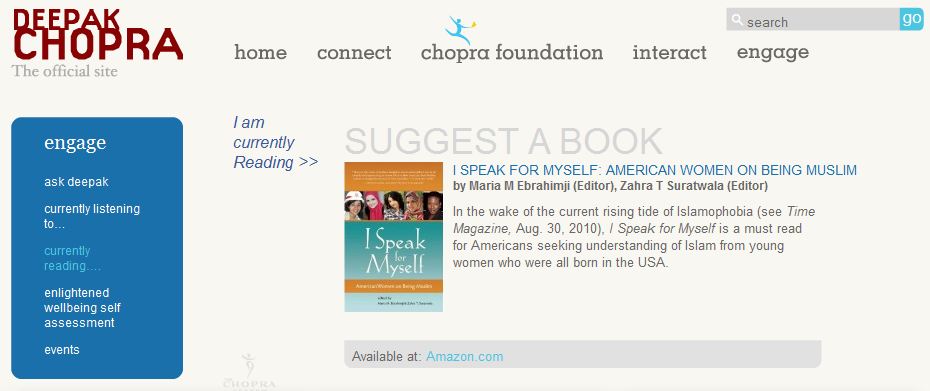
Steve mentioned that we’d gotten a review in Publisher’s Weekly, and today a colleague mentioned that ISFM was on the front page of Deepak Chopra’s website! The historian in me had to take a screenshot for the record:

ISFM will be in bookstores next week, but you can order it from the publisher now at a pretty sweet discount. Make sure to check it out!

I’m going to be published again!

Friends, I’m excited to announce that I’ll be published again in a few months! I’m proud to share that I’ve been included in an amazing group of American Muslim women whose essays will appear in an anthology to be published in early summer 2011. This is directly from the press release:

Islam has become one of the hottest of hot button topics in America. Time Magazine featured the rise of Islamophobia on its cover (August 30, 2010) and attacks on Muslims and mosques are taking place regularly across the United States. Pundits and politicians raise the stakes by questioning whether it is possible for an American to be both a good Muslim and a good citizen. Muslim American women are the subject of endless discussions regarding their role in society, their veils as symbols of oppression or of freedom, their identity, their patriotism.

In this polarized climate, a new book challenges stereotypes about being Muslim in America through the stories of forty women. I Speak for Myself: American Women on Being Muslim (May 2, 2011, White Cloud Press) brings together a diverse group of women, all born and raised in the United States, telling their stories of faith, family, and country. Some contributors wear traditional head coverings (hijab) while some do not. Some are Sunni, some Shi‘i. The writers’ ethnic backgrounds are Arab, African-American, Pakistani, Indian, Iranian, and Afghan.  Each addresses a personal aspect of her life with regards to being a Muslim and being an American.

The book editors are Maria Ebrahimji, executive editorial producer at CNN in Atlanta, and Zahra Suratwala, a writer and editor who owns Zahra Ink, a writing firm in Chicago. The editors wanted to fill a gap in current literature on American Islam by bringing out the stories of American-born Muslim women between the ages of 20 and 40. Ebrahimji notes that “As a member of the mainstream media, I am frequently exposed to the stereotyping of my faith, and this book was created to present the public with more candid, realistic portraits of a diverse group of women who are proud of their faith and their country.”

Readers of I Speak for Myself are presented with a kaleidoscope of deeply personal stories. A common theme linking these intimate self-portraits is the way each woman uniquely defies labeling, simply by defining for herself what it means to be American and Muslim and female.  Each story is a contribution to the larger narrative of life stories and life work of a new generation of Muslim women.

The essays featured in I Speak for Yourself are not intended to be reactionary to the current climate of suspicion towards Islam in America, but they certainly address such suspicion in a very personal way. The contributors embody real everyday American women who struggle with their faith while balancing their careers and private life.

You can pre-order a copy of the book and check out all the contributors (including me) at the website here. You can also check us out on Facebook and Twitter!

I’m making waves online!

…so says the wonderful interfaith site Tikkun! The ever-vibrant Amanda Quraishi profiles me for Tikkun’s “Muslims on the Internet” series:

Needless to say, MMW does not fit neatly into any one blogging category, but it’s precisely for this reason that it’s become a beacon for Muslim women online. “The knowledge that our website is used in university level gender studies classrooms is what I’m most proud of,” Fakhraie tells me. “The majority of my Islamic feminist studies didn’t come to me until late in my college career; I’m supremely happy that we can reach feminists (both Muslim and non-Muslim) earlier. I also think that Muslimah Media Watch is a defining feminist voice in the Muslim blogosphere. Not all of our writers identify as feminist, but our pro-women bent is prominent.”

This is the first post in the “Muslims on the Internet” series, which looks at “Muslim activists, entrepreneurs and artists who are making waves online.” Check it out!

A little part of me is in Italy right now.

The Fifth International Conference on Design Principles and Practices started today. It’s a huge apparel and fashion themes and theories conference, and this year, it’s held at Sapienza University of Rome in Rome, Italy.

And the reason I’m posting about it is because my former professor, Dr. Kathy Mullet, will be presenting my research on hijab style preferences and urban Iranian women there! While I’d love to be there presenting my research, I’m pleased that my work is reaching a broader academic audience.

Odds and ends

Farah Pandith, the Secretary of State’s Special Representative to Muslim Communities, recently launched a newsletter, voices. You’ll remember that I attended the Secretary of State’s Ramazan iftar last September; the newsletter talks about it and even includes a picture with me (on page 2 at the bottom).

Also, my friend Thea Lim reminded me that my article “Scarfing it down,” appears in the eighth edition of Writing Arguments: A Rhetoric with Readings, which she’s using in her writing classes. It’s humbling to know that I’m part of a textbook that teaches university  students critical thinking. Lots of MMW articles are used in university-level gender studies classes, and this article is just one more aspect of my work that I’m proud of.

Lots of exciting things are coming up in the next few months, so stay tuned for more!

Iran and Saudi Arabia on UN women’s rights council?

I think it’s a bad idea, given that neither country had made demonstrable commitments to women’s and human rights.

Yes, Saudi Arabia has signed onto CEDAW, but how has it improved things for women in the country? And how could a place on the committee be anything more than fake feminist cred for Iran? It’d be like handing them a “get out of women’s rights jail free” card.

I share my opinion with The Los Angeles Times. Check it out.


*blush*

I’m a little (okay, a lot) late on this, but…

Amazing writer Jillian C. York included me as one of her “5 Writers You Should be Reading,” grouping me with such amazing writers as Glenn Greenwald and Ta-Nehisi Coates. I’m flattered and incredibly humbled by the inclusion.

York’s work is serious–she is a prolific writer on issues regarding internet censorship and The Middle East.

So you’d better listen to her and read me.

The Camouflaged Cartoonist

I was unhappy to read that “Draw Muhammad Day” creator Molly Norris had voluntarily gone into hiding. While I thought the concept of “Draw Muhammad Day” was ridiculous and viewed it in the same light as the South Park episode that supposedly depicted the prophet, I recognize that Norris’ intent wasn’t to be offensive or malicious. In Islam, intentions count for something just like actions, and no one should be punished for simple naïveté. It’s atrocious that Norris has received threats and feels unsafe enough to go incognito.

Which is why I’ve added my name to the list of American Muslims in the media who support Molly Norris and her right to free speech. My signature on a statement isn’t going to do much for her, but I hope she understands that she has our support.

A DEFENSE OF FREE SPEECH BY AMERICAN AND CANADIAN MUSLIMS

We, the undersigned, unconditionally condemn any intimidation or threats of violence directed against any individual or group exercising the rights of freedom of religion and speech; even when that speech may be perceived as hurtful or reprehensible.

We are concerned and saddened by the recent wave of vitriolic anti-Muslim and anti-Islamic sentiment that is being expressed across our nation.

We are even more concerned and saddened by threats that have been made against individual writers, cartoonists, and others by a minority of Muslims.  We see these as a greater offense against Islam than any cartoon, Qur’an burning, or other speech could ever be deemed.

We affirm the right of free speech for Molly Norris, Matt Stone, Trey Parker, and all others including ourselves.

As Muslims, we must set an example of justice, patience, tolerance,  respect, and forgiveness.

The Qur’an enjoins Muslims to:
* bear witness to Islam through our good example (2:143);
* restrain anger and pardon people (3:133-134 and 24:22);
* remain patient in adversity (3186);
* stand firmly for justice (4:135);
* not let the hatred of others swerve us from justice (5:8);
* respect the sanctity of life (5:32);
* turn away from those who mock Islam (6:68 and 28:55);
* hold to forgiveness, command what is right, and turn away from the ignorant (7:199);
* restrain ourselves from rash responses (16:125-128);
* pass by worthless talk with dignity (25:72); and
* repel evil with what is better (41:34).

Islam calls for vigorous condemnation of both hateful speech and hateful acts, but always within the boundaries of the law. It is of the utmost importance that we react, not out of reflexive emotion, but with dignity and intelligence, in accordance with both our religious precepts and the laws of our country.

We uphold the First Amendment of the US Constitution and the Canadian Charter of Rights and Freedoms.  Both protect freedom of religion and speech, because both protections are fundamental to defending minorities from the whims of the majority.

We therefore call on all Muslims in the United States, Canada and abroad to refrain from violence.  We should see the challenges we face today as an opportunity to sideline the voices of hate—not reward them with further attention—by engaging our communities in constructive dialogue about the true principles of Islam, and the true principles of democracy, both of which stress the importance of freedom of religion and tolerance.

You can see the entire statement and signatories here. May God keep you safe, Molly Norris, wherever you are.
On campus discrimination and Muslim students

I’m interviewed for Oregon State University’s daily paper The Daily Barometer about discrimination that Muslim students face on-campus:

Fatemeh Fakhraie, an employee for the INTO OSU program, feels that the university is “a welcoming place” for Muslim students and her “experience at OSU has been overwhelmingly positive.”

Read the entire thing at the paper’s website here.